- June 19, 2026
- 0
Mercedes AdBlue Warning: Causes, NOx Sensor Failures and How to Fix It
A Mercedes AdBlue Warning is one of the most frustrating faults a diesel owner can face. What often starts as a simple emissions issue can quickly escalate into expensive diagnostics, NOx sensor replacement, or the dreaded “No engine start in XXX miles” warning. Understanding what causes a Mercedes AdBlue Warning can save owners hundreds, and in some cases thousands, in unnecessary repairs.
Modern diesel vehicles from Mercedes-Benz rely heavily on SCR (Selective Catalytic Reduction) technology to meet emissions regulations. However, while the system works well when healthy, it has introduced some serious reliability concerns, particularly around NOx sensors and AdBlue delivery systems.
For many owners, the result has been inconvenience, cost, and in some cases enough frustration to abandon the brand altogether.
What Causes a Mercedes AdBlue Warning?
A Mercedes AdBlue Warning usually appears when the vehicle detects an issue within the SCR emissions system.
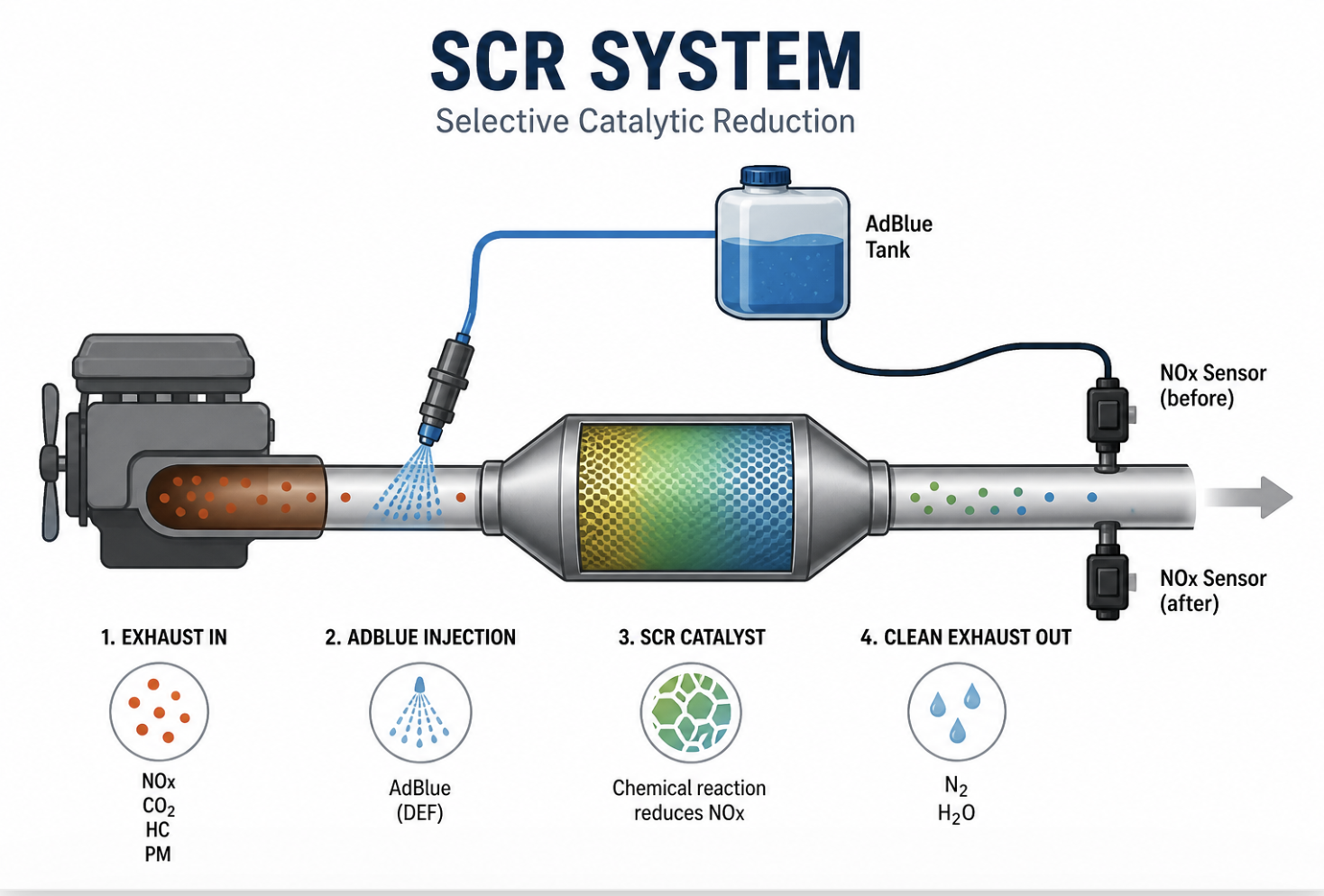
The SCR system uses AdBlue fluid to reduce harmful nitrogen oxide emissions. The vehicle injects AdBlue into the exhaust system, where it reacts in the catalyst to reduce NOx gases.
When this process is interrupted, the ECU flags a fault.
Common causes include:
- Failed NOx sensors
- AdBlue contamination
- AdBlue injector blockage
- SCR catalyst efficiency faults
- Reductant pressure issues
- Tank heater faults
- Crystallisation build-up
- AdBlue quality issues
A Mercedes AdBlue Warning often starts small, but ignoring it can lead to immobilisation.
That is what makes it so serious.
Mercedes AdBlue Warning and NOx Sensor Failures
One of the most common reasons for a Mercedes AdBlue Warning is NOx sensor failure.
NOx sensors measure emissions before and after SCR treatment. If those readings fall outside expected values, the system assumes emissions compliance has failed.
This triggers fault codes and, often, a countdown to no-start.
The problem is scale.
Mercedes reportedly replaced close to 50,000 NOx sensors in one year across affected diesel platforms, a number that raises serious questions about reliability expectations.
At that volume, this stops looking like isolated wear and starts looking like a systemic weakness.
For owners, this became expensive.
A NOx sensor replacement often includes:
- diagnostics
- sensor replacement
- coding
- adaptations
- fault resets
Costs can quickly rise.
And worse than cost is inconvenience.
A failed sensor can begin the countdown even when the engine itself is mechanically perfect.
That experience has pushed many owners away from diesel Mercedes ownership entirely.
Not because the engines are poor.
Because the emissions systems became expensive and unforgiving.
Mercedes AdBlue Warning: Why the No Start Countdown Happens
The most feared part of a Mercedes AdBlue Warning is the countdown.
Mercedes designed the SCR system to enforce emissions compliance.
If the system cannot verify proper operation, the ECU begins limiting restart capability.
You may see:
- No engine start in 500 miles
- No engine start in 200 miles
- No engine start in 50 miles
This means one thing.
Fix it before the counter reaches zero.
Ignoring a Mercedes AdBlue Warning can result in a vehicle that will not restart after being switched off.
For many owners, that creates a crisis.
Especially if:
- travelling
- working
- delivering goods
- on holiday
A sensor fault should not immobilise a vehicle.
Yet here we are.
Common Fault Codes Behind a Mercedes AdBlue Warning
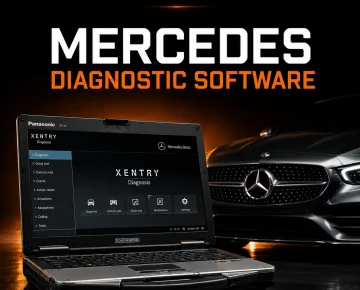
Using Mercedes-Benz Xentry, workshops regularly see these SCR-related codes:
P13DF
AdBlue system malfunction.
P2201
NOx sensor performance issue.
P229F
NOx sensor range fault.
P20EE
SCR efficiency below threshold.
P204F
Reductant system performance.
P206B
AdBlue quality issue.
A Mercedes AdBlue Warning can be triggered by any of these.
However, fault codes are clues.
Not conclusions.
That distinction matters.
How to Fix a Mercedes AdBlue Warning
Fixing a Mercedes AdBlue Warning depends entirely on diagnosis.
Too many people replace parts first.
That is backwards.
The correct order:
- Diagnose
- Confirm
- Repair
Possible repairs include:
- replacing NOx sensors
- cleaning AdBlue injectors
- repairing wiring
- clearing contamination
- resetting adaptations
- correcting fluid quality
Diagnosing a Mercedes AdBlue Warning properly avoids unnecessary parts replacement.
That alone can save hundreds.
For dealer-level diagnosis, use our internal Mercedes diagnostic range here (insert your Mercedes category link).
Best Diagnostic Tools for a Mercedes AdBlue Warning
When diagnosing SCR faults, generic scanners often fall short.
A cheap scanner might read codes.
But it cannot perform proper adaptations or live NOx testing.
That matters.
Mercedes-Benz Xentry
This is the factory-level system.
Best for:
- live NOx readings
- AdBlue injector testing
- SCR resets
- coding
- guided diagnostics
Using dealer-level diagnostics like Mercedes Xentry can identify SCR faults properly.
(Insert your Xentry product link here)
For official manufacturer servicing information, refer to Mercedes-Benz Group AG technical resources.
For UK emissions compliance guidance, refer to Driver and Vehicle Standards Agency.
These outbound authority references help verify technical standards.
Can a Mercedes AdBlue Warning Be Fixed Without Replacing Parts?
Yes.
Sometimes.
Not every Mercedes AdBlue Warning means a failed NOx sensor.
This is where many workshops and owners make expensive mistakes.
Many SCR faults are caused by:
- contamination
- crystallisation
- restricted injector flow
- poor-quality AdBlue
- partial blockages
These conditions can mimic hardware failure.
That means the sensor gets blamed when contamination is the real issue.
That distinction matters.
Before Replacing Parts, Try Liquid OBD
At OBD Store, we developed Liquid OBD AdBlue System Recovery Fluid as a practical first step before expensive parts replacement.
Our product is designed to tackle contamination and crystal build-up inside the AdBlue system.
Liquid OBD helps:
- break down crystal build-up
- clean fluid paths
- improve injector flow
- restore dosing efficiency
- support SCR system performance
For contamination-related faults, our Liquid OBD AdBlue recovery fluid can be used before replacing expensive components.
(Insert your Liquid OBD product link here)
This is not a miracle product.
If the NOx sensor has electrically failed, replacement is necessary.
But if contamination is the issue, this can be the cheapest place to start.
That matters because a bottle costs far less than a sensor.
How to Use Liquid OBD
Application is simple:
- Add Liquid OBD into the AdBlue tank
- Top up with fresh AdBlue
- Drive normally
- Stop and restart during the cycle
- Recheck faults using Mercedes-Benz Xentry
Many contamination-based faults improve within around 100 miles.
Results vary by severity.
Why Mercedes Owners Should Take a Mercedes AdBlue Warning Seriously
A Mercedes AdBlue Warning is not just another dashboard light.
It is a system warning that can quickly escalate into immobilisation.
That changes everything.
The frustration for many owners is not simply that parts fail.
Parts always fail.
It is that emissions faults can disable an otherwise perfectly functional vehicle.
That design choice has damaged trust.
And when the most common weak point is a sensor with high replacement volumes, owners naturally question reliability.
Final Thoughts on Mercedes AdBlue Warning Faults
A Mercedes AdBlue Warning should never be ignored.
The causes range from contamination to NOx sensor failure, and the costs vary dramatically depending on how the problem is approached.
Start with proper diagnosis.
Use the correct tools.
Rule out contamination.
Then replace parts only when confirmed.
If you need dealer-level Mercedes diagnostics, view our full Mercedes diagnostic tool range (insert internal link).
If you want the cheapest practical first step before expensive replacement, try Liquid OBD AdBlue System Recovery Fluid from OBD Store.
A proper diagnosis costs less than guesswork.
Wrong parts cost more than the fault itself.
If you own a diesel Mercedes-Benz built in the SCR emissions era, there is a fair chance you have seen this warning:
No engine start in 500 miles
Few dashboard warnings create more anxiety.
Not because the car suddenly becomes unsafe.
Not because the engine itself has failed.
Because a problem in the emissions system can begin a countdown that may eventually stop the car from restarting altogether.
For many owners, the problem begins in the AdBlue system.
And for a significant number, it ends with a failed NOx sensor, a large repair bill, and a serious question about whether modern diesel emissions systems were ever made robust enough for real-world ownership.
What is the Mercedes AdBlue system?
AdBlue is a diesel exhaust fluid used in SCR (Selective Catalytic Reduction) systems to reduce nitrogen oxide emissions.
The system works by injecting AdBlue into the exhaust stream, where it helps convert harmful NOx gases into nitrogen and water.
In principle, it is effective.
In practice, it introduced a new layer of complexity.
And complexity creates failure points.
The most common AdBlue-related failures on Mercedes vehicles include:
- NOx sensor failure
- SCR efficiency faults
- AdBlue injector blockage
- AdBlue crystallisation
- tank heater faults
- pump pressure faults
- reductant quality issues
- tank level sensor failure
Any one of these can trigger a fault.
Some trigger a countdown.
That countdown is where inconvenience becomes disruption.
The NOx sensor problem Mercedes owners know too well
The NOx sensor has become one of the most frequently replaced components in modern Mercedes diesel emissions systems.
Its job is simple.
Measure nitrogen oxide levels before and after treatment and report back to the ECU.
If it reports values outside tolerance, the SCR system assumes emissions compliance has failed.
That often triggers the no-start countdown.
The problem is that these sensors fail far too often.
Reports from the industry and workshop data showed Mercedes replaced tens of thousands of NOx sensors in a single year, with figures approaching 50,000 units across affected platforms.
That is not ordinary wear.
That is volume failure.
At that scale, it becomes fair to ask whether this was a reliability defect rather than bad luck.
For owners, the impact was substantial.
A NOx sensor replacement can involve:
- dealer diagnostics
- sensor replacement
- ECU resets
- AdBlue adaptations
- labour charges
The bill can quickly climb into hundreds or even thousands.
And worse than cost was the timing.
Many failures occurred without warning.
A perfectly usable car suddenly became a countdown vehicle.
That inconvenience pushed many owners away from the brand altogether.
Not because the engines were bad.
Because the emissions systems became expensive, inconvenient and unforgiving.
Why the “No Start in XXX Miles” warning is so serious
Mercedes engineered the SCR system to enforce repair compliance.
If emissions performance cannot be verified, the system begins limiting operation.
You may see:
- No start in 500 miles
- No start in 200 miles
- No start in 50 miles
Once that reaches zero, the vehicle may refuse to restart.
That creates a brutal reality.
A failed sensor can immobilise an otherwise mechanically healthy vehicle.
Imagine this happening:
- before work
- during delivery routes
- on holiday
- in winter
- in remote areas
That is why AdBlue faults create so much frustration.
The engine may be perfect.
The emissions system says otherwise.
And the system wins.
Common Mercedes AdBlue fault codes
Using Mercedes-Benz Xentry, these are commonly seen:
P13DF
AdBlue system malfunction.
P2201
NOx sensor performance problem.
P229F
NOx sensor out of range.
P20EE
SCR efficiency below threshold.
P204F
Reductant system performance.
P206B
Reductant quality problem.
These faults can mean:
- failed NOx sensor
- contaminated AdBlue
- crystallised injector
- blocked dosing line
- poor fluid quality
- SCR catalyst inefficiency
The fault code tells you where to look.
It does not always tell you what to replace.
That distinction saves money.
Why cheap diagnostic tools often fail here
A generic OBD scanner can often read fault codes.
That sounds useful.
But on Mercedes SCR faults, reading codes is only the beginning.
Proper diagnosis often needs:
- live NOx value comparison
- AdBlue pressure testing
- injector actuation testing
- SCR adaptation resets
- ECU guided testing
- component teaching
Cheap scanners cannot reliably do this.
Factory-level systems can.
That is why professional workshops use Mercedes-Benz Xentry.
Because replacing parts without proper testing is expensive guesswork.
Best tools for diagnosing Mercedes AdBlue faults
Mercedes-Benz Xentry
This is the dealer system.
Best for:
- full system diagnostics
- live sensor data
- AdBlue adaptations
- SCR resets
- coding
- guided diagnostics
If you work on Mercedes regularly, this remains the strongest option.
In the diagnostics section
Replace:
For dealer-level diagnosis, use our internal Mercedes diagnostic range here
Can AdBlue faults be fixed without replacing parts?
Yes. Sometimes.
And this is where many owners waste money.
Not every SCR fault means hardware failure.
In many cases, the system suffers from:
- contamination
- poor-quality AdBlue
- crystallisation build-up
- injector restriction
- poor spray pattern
- dosing inefficiency
These issues can create fault codes that mimic component failure.
That means a sensor may be blamed when the root cause is elsewhere.
This matters.
Because replacing parts first is often the most expensive route.
Diagnosis first.
Treatment second.
Parts third.
That order matters.
Before replacing expensive parts, try Liquid OBD
At OBD Store, we developed Liquid OBD AdBlue System Recovery Fluid to tackle one of the most overlooked causes of SCR faults:
system contamination.
AdBlue systems suffer from internal crystal build-up, deposits, and contamination that can affect flow, injector atomisation and system efficiency.
Liquid OBD was designed as a workshop-first solution.
A practical first step before replacing expensive hardware.
It is designed to:
- break down AdBlue crystal build-up
- improve fluid path cleanliness
- restore injector efficiency
- improve SCR flow characteristics
- reduce contamination-related system faults
In workshop testing, it has shown strong results on commercial and passenger vehicle systems.
Particularly on DAF Trucks platforms, where AdBlue contamination faults are extremely common.
It has also performed strongly on Mercedes passenger vehicles and vans.
Shop Liquid OBD AdBlue System Recovery Fluid here:
Liquid OBD
How to use Liquid OBD
Application is simple:
- Add Liquid OBD directly into the AdBlue tank
- Top up with fresh AdBlue
- Drive normally
- Stop and restart during the drive cycle
- Recheck faults with Mercedes-Benz Xentry
Many systems show improvement within approximately 100 miles depending on contamination levels.
Important:
Liquid OBD is not a magic fix.
If the NOx sensor has electrically failed, it must be replaced.
But if the issue is contamination, crystal restriction or poor dosing performance, Liquid OBD can often be the cheapest and smartest first move.
Before spending £800 on parts, spending a fraction of that to rule out contamination is simply logical.
Final thoughts
Mercedes diesel engines remain some of the best engineered engines on the road.
That is not the issue.
The issue is the emissions architecture attached to them.
The AdBlue and NOx sensor system has created avoidable cost and inconvenience for thousands of owners.
The biggest frustration is not that parts fail.
Parts always fail.
It is that when they fail, the car can punish the owner with immobilisation.
That design philosophy has damaged owner confidence.
If you are facing:
- AdBlue warning messages
- NOx sensor faults
- SCR efficiency codes
- no-start countdown warnings
do not guess.
Diagnose properly.
And before replacing expensive components, consider whether contamination is the real problem.
If it is, Liquid OBD AdBlue System Recovery Fluid may be the cheapest fix you try.
Related Article
How Mercedes diagnostics evolved in the last 2 years
- May 5, 2026
- Industry related news and articles
related posts