- September 9, 2026
- 0
What OBD2 Actually Is
OBD2 stands for On-Board Diagnostics, version 2. It is the standard connector and communication protocol fitted to every car sold in the UK and Europe since 2001 (petrol) and 2004 (diesel). Your car’s ECU constantly monitors the engine, emissions, and other systems. When something goes wrong, it stores a fault code and turns on the check engine light.
OBD2 is the socket under your dashboard, the language the car speaks, and the reason any OBD scanner can plug in and read faults on almost any vehicle.
Where to Find the OBD2 Port
Look under the dashboard on the driver’s side, usually within arm’s reach of the steering column. It is a 16-pin trapezoid socket, the same on every car. Some are behind a small cover or flap. If you cannot find it, check the fuse box area or the centre console.
What an OBD2 Scanner Does
An OBD2 scanner plugs into that port and talks to the ECU. Even the cheapest code reader can:
- Read and clear stored fault codes
- Display live data such as RPM, coolant temperature, and oxygen sensor readings
- Show freeze-frame data captured at the moment a fault occurred
- Run basic readiness monitors for emissions testing
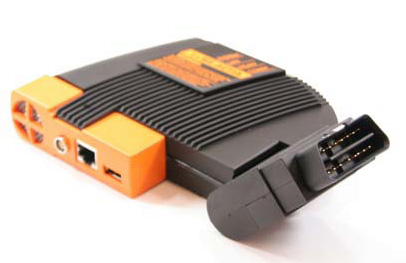
A professional diagnostic tool goes further: full system scans across engine, gearbox, ABS, airbag, and more, plus bi-directional testing, ECU coding, and manufacturer-specific functions.
Fault Codes Explained
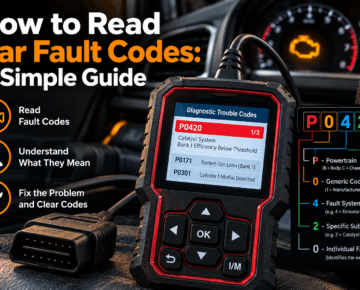
Fault codes follow a simple five-character pattern. Take P0301 as an example:
- P — Powertrain (engine and gearbox). B is body, C is chassis, U is network.
- 0 — Generic (SAE standard). A 1 means manufacturer-specific.
- 3 — The system: fuel and air, ignition, emissions, and so on.
- 01 — The specific fault. In this case, cylinder 1 misfire.
Reading the code tells you what the car thinks is wrong. The actual diagnosis comes from the live data, not the code alone.
Generic vs Manufacturer-Specific Diagnostics
Generic OBD2 covers the basics on every car. But modern vehicles have dozens of modules beyond the engine, and many use proprietary protocols. A generic scanner will read engine codes on a Mercedes but will not touch the transmission, air suspension, or SRS module.
Manufacturer-specific tools such as Mercedes Xentry, VAG ODIS, or Ford IDS give dealer-level access to every module, plus coding, programming, and guided diagnostics. If you work on one brand regularly, a dedicated tool pays for itself.
Choosing Your First Tool
If you are new to diagnostics, start with a code reader that reads and clears codes and shows live data. Once you know what you need, step up to a full diagnostic scanner. Our guide to picking the right OBD2 scanner breaks down the options by budget and use case.
If you need a tool to get started, browse our range of OBD readers and car diagnostic tools.
- October 23, 2026
- Auto Diagnostics How To Do's
related posts